What Is a Sourcing Agent and When Do You Need One?
A sourcing agent is a fee-based buying office in China: they vet factories, run samples, inspect before shipment and consolidate orders. What the job involves, and when you need one.


A China sourcing agent is an independent buying office in China. You pay them a fee, and they find and vet factories, negotiate price and terms, run sample rounds, inspect quality before shipment, and consolidate goods from several suppliers into one order. They are not the manufacturer, and in a fee-based engagement they do not buy and resell what they source for you.
That distinction is the whole game. A trading company earns a margin on what it sells you; an agent earns a fee from you. When price and quality conflict, those two models point in opposite directions — which is why the first question to ask any provider is not “what can you source?” but “how do you get paid?”
The short version
- A sourcing agent is a fee-based buyer’s representative in China, not a reseller: they work from your specification and are paid by you.
- You need one when the product is made to your spec, when you are coordinating three or more suppliers, or when nobody on your side can stand in a factory.
- Budget for a 5–10% commission on full-service work, or a fixed monthly retainer, and insist on seeing factory cost and agent fee as two separate numbers.
The Definition, Without the Sales Pitch
Think of an agent as a purchasing department you rent. The deliverable is not a website or an introduction to a factory — it is a product that matches your specification, at a price you can defend, delivered when you said it would be.
Day to day, that means a chain of unglamorous steps: turning your brief into a specification a Chinese factory can quote against, shortlisting factories that actually make the category (supplier management covers how that list is built and re-checked), negotiating price and tooling, running samples, following the line once production starts, inspecting before the balance payment, and consolidating several suppliers into one shipment carrying your labels. Our own version of that chain is broken into eleven stages on the service overview, and the inspection side is described in more detail under quality assurance.
The part most buyers do not expect: a good agent spends real time telling you no. Your target price is not achievable with that finish. That deadline is not realistic. This factory’s capacity cannot be verified, so use the other one. An agent who never pushes back is usually protecting the relationship, not your order.
When buyers search for a “product sourcing agent,” this is what they are usually after: someone who can take a category they do not know and identify the few factories in it worth talking to. That is also the honest limit of the job. Agents tend to be strong in a handful of categories and ordinary outside them — few teams are equally good at electronics, cosmetics and furniture. A narrow, confident answer is a better sign than a broad one.
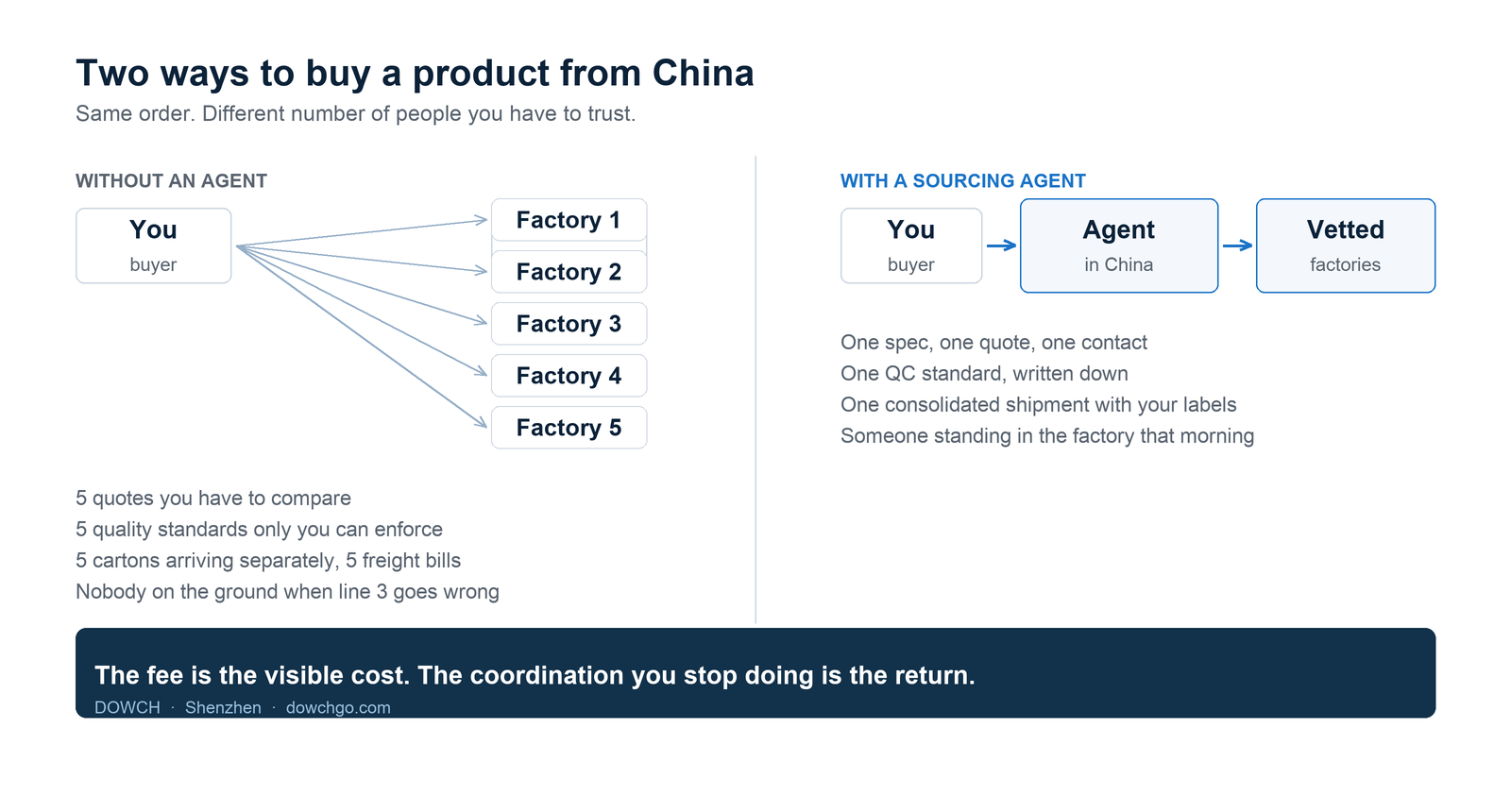
Two Ways to Buy the Same Product
The difference is not effort, it is coordination. One route puts every supplier, quote, inspection and carton on your desk. The other collapses that into a single thread of communication.
What a Sourcing Agent Is Not
Four things get called an agent that are not one. The distinctions matter because each changes who is accountable when something goes wrong.
A trading company
A trader buys the goods and resells them to you, keeping the difference. That model can work well — trading companies often carry a wide catalog and handle paperwork efficiently — but its incentive is the margin on the sale, not the specification behind it.
A freight forwarder
Forwarders move cargo and handle documentation. They do not read a spec sheet, reject a sample, or notice that a carton print is one Pantone shade off.
A marketplace
Platforms are good at discovery, payment protection and dispute handling. What they cannot do is stand in your factory on the morning a production run starts drifting, or verify that the goods match a specification nobody wrote down. Some offer inspection add-ons; they are still not your representative in the building.
An inspection company
Third-party inspection is a valuable service and often quoted per man-day. But inspection happens at the end of the process. The decisions that save the most money — which factory, which material, which tolerance — are made long before an inspector arrives.
For the full comparison — including how dropshipping platforms fit and who each model serves when price and quality conflict — see How to Find a Reliable China Sourcing Agent.
The Three Realistic Ways to Get a Product Made in China
Most buyers consider only the first and third options below. The middle one is usually skipped because it sounds expensive, yet it is the option that most often fails quietly: managing an employee in a country you have never worked in is harder than it looks.
| Route | What it costs | Time to first order | What you still handle |
|---|---|---|---|
| Direct with factories | No fee; you keep the full margin if you can negotiate the price | Often three to six months of learning, travel and failed samples | Specifications, QC, consolidation, freight and claims |
| Hire your own person in China | A local salary plus office, visa and management overhead; ranges vary widely by city and experience | Recruiting, then a ramp-up period measured in months | Managing them, and covering the categories they do not know |
| Work with a sourcing agent | Typically a commission on order value, or a fixed retainer for project work | Days to an itemized quote, then sample rounds | Approving the specification, the samples and the purchase order |
Cost figures here are deliberately left as ranges: what an in-house hire or an agent costs depends on the city, the category and how much of the process they carry. Any provider quoting you a single number without asking about volume and specification is guessing.

Five Signs You Need One Now
If two or more of these are true, the cost of not having someone on the ground is already being paid — you just cannot see the line item.
- The product does not exist on a listing yet. It has to be made to your specification: dimensions, materials, finish, packaging. No marketplace will quote a product that is not already in a catalog.
- You are buying from three or more suppliers. At that point you are running a logistics operation by accident — separate quotes, separate inspections, separate cartons, separate freight bills.
- You have already lost a quality dispute. A platform ticket that ends in a partial refund is not a quality system. It is the fee you paid to learn that nobody was standing in the factory.
- Your margin per unit is thin. When you make a dollar or two a unit, an 8% defect rate does not reduce profit — it reverses the order.
- You are about to sign a purchase order you cannot read. Not because Chinese is difficult, but because the specification in it is the only thing that will be enforced later.
When You Do Not Need One
We sell this service, so hold us to this section.
- You are testing a product. A dropshipping platform or marketplace is cheaper and faster for validating demand. Pay for sourcing once you know the product sells.
- One mature SKU, high volume, a factory that already performs. Go direct. At that stage an agent’s commission is a permanent tax on a relationship you already manage well.
- You already have a competent team in China. Spend the money on independent inspection instead — per-visit checks on your existing suppliers, with no sourcing fee attached.
- Price is your only decision variable. If you will accept whatever arrives as long as it was cheap, an agent’s fee will feel like a monthly penalty. That is a legitimate business model; it is simply not one where this service pays for itself.
What It Costs — and the Number That Actually Matters
Fee structures are simple to describe. Full-service sourcing is usually commissioned at 5–10% of order value, falling to 3–5% on straightforward repeat orders. Project work is often a fixed monthly retainer, light coordination can be charged per order, and independent inspection is usually quoted per man-day. These are market reference ranges compiled from publicly listed provider rates, not a standard schedule and not DOWCH’s price list; pricing moves with category, order size and scope.
One number deserves suspicion: a stated 0% fee. An agent has to be paid by someone. When the factory pays, the cost reappears inside your unit price, and you lose the ability to see it. Ask for the factory price and the agent fee as two separate figures, and the comparison between providers becomes meaningful.
The fee still is not the number that decides whether hiring an agent was worth it. Your landed cost per good unit is — calculated after defects, rework, consolidation and delay. A rough version:
Take 1,000 units at $4 each: a $4,000 order. If 8% arrive unsellable, you have lost $320 in goods, plus the freight you paid on them, plus an answer to your own customers. An 8% agent fee on the same order is also $320. The fee stops looking expensive the moment it prevents one bad batch, and looks expensive the moment you are paying it for a product you could have bought from a listing.
What the First Order Looks Like
Nothing dramatic. The sequence is short, and every stage has a point where you can still walk away.
- Specification and target priceYou send photos, dimensions, materials and the price you need. You get back an itemized quote with the fee separated, plus honest feedback on what your target price can and cannot buy.
- Samples from two factoriesCompared side by side against your specification, not against each other’s photographs. Sample and courier costs are yours; treat a few hundred dollars as tuition.
- A pilot order with an inspection gateHundreds of units rather than thousands, with a written inspection report before the balance payment. That report is the point of the exercise.
- A review of the paper trailDid the report arrive without you chasing it? Were delays flagged early? One order tells you more about an agent than five sales calls.
If you have not chosen the agent yet, start with vetting rather than pricing — the twelve checks we would run ourselves are in the agent-selection guide.
Want a second pair of eyes on a supplier you are already talking to?
FAQ
They act as your purchasing department inside China: turning a brief into a factory-ready specification, vetting suppliers, negotiating price and terms, managing samples, following production, inspecting before shipment and consolidating goods from several factories into one shipment. They are paid by you and do not take ownership of what they source.
Full-service work is commonly commissioned at 5–10% of order value, with 3–5% on simple repeat orders. Project work is often a monthly retainer, light coordination can be charged per order, and third-party inspection is usually quoted per man-day. Treat these as reference ranges rather than standard rates.
No. A trading company buys goods and resells them at a markup. A sourcing agent works for a fee paid by you and stays neutral between factories. Many agencies are trading companies in disguise, so the practical test is whether they disclose the factory and separate product cost from their fee.
Yes, and it is routine work: your logo on the product, retail-ready boxes, inserts and labels. Ask for photographs of real packaging runs with client artwork — our packaging service page shows the formats we prepare — and ask what minimum the packaging itself triggers — boxes have their own print minimums, separate from the product.
Not always. For in-stock items, small orders are workable, and some providers have no minimum. But below roughly $1,000–2,000 per order, a marketplace is usually the cheaper tool; the fee only starts paying for itself once there is customization or real quality risk.